 AutoSlid
A cared-for car is worth more — if you can prove it was
When to service it, where to get that done, and what proves to a buyer that it really was looked after. The history belongs to the car rather than to your account and cannot be rewritten after the fact — which makes it evidence rather than your word. For a driver all of this is free — the service plan, the reminders and alerts, the workshop catalogue, OBD diagnostics and roadside SOS — and it stays free.
On Google Play now, free. The App Store comes later.
- Ukraine’s MVS register since 2021
- National Police wanted list
- Check by VIN or body number
- Free for drivers

A wound-back odometer and a service book filled in the night before the sale are an everyday story in the used-car market. AutoSlid’s records are built so that neither can be done unnoticed.
A history that proves, not one that tells
An ordinary logbook app remembers what you typed and lets you change it. Handy for you, but it convinces no buyer. So AutoSlid works differently.
Through the buyer's eyes
The car's own screen says what a stranger would read in its history: where the silence is, where the mileage does not add up, which record has no paper behind it — and what the history already says for you. When there is nothing to stumble over, it says so.
Workshops the records vouch for
Where to get it done, on a map, in an order nobody paid for: did anybody go back a second time, how many different owners, is the place still working, how much work. Only somebody with a record of that visit can rate it.
Records cannot be rewritten
A record cannot be edited or deleted — not even by the owner. A mistake is voided with a reason, and the voided record stays visible. This lives in the database’s rules, not only in the app.
You can see when it was logged
Every record carries two dates: when the work was done and when it was entered. The past closes after 30 days, so nobody can “remember” a spotless history the week before a sale.
The history belongs to the car
When you sell, you hand the car to its new owner with a code, and the whole history goes with it. They carry it on instead of starting from scratch. Your private expenses stay yours.
You open the history, not us
Your car's history is closed until you open it — by a link, or in answer to a buyer's request. A VIN check says whether the car is in AutoSlid and whether it has a service history, and shows not one record without your say-so. And never your name, what you paid or your photos. No ads, and we do not sell personal data.
The app reads the car itself
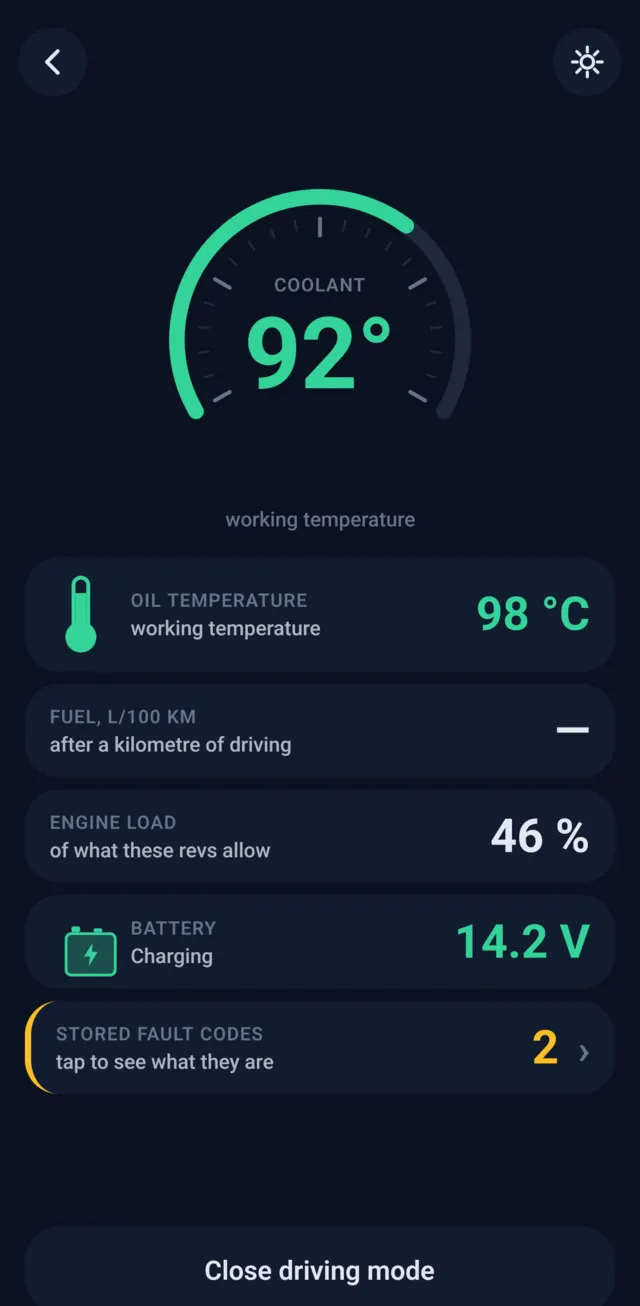
Plug in an inexpensive OBD-II adapter and AutoSlid reads the engine's fault codes and explains them, shows coolant and oil temperature and the charging voltage as you drive, records the trip, and takes the mileage from the control unit — the one figure no instrument cluster ever drew. Codes are filed in the history with their date.
Care for your car, not for an average one
After a short first questionnaire the schedule fits how and where you drive: salted roads, the city, dust, the gearbox, the drivetrain, gas equipment, the brakes.
- Reminders by mileage and time — whichever comes first. The critical ones first.
- Seasonal work as windows: changing tyres in autumn and spring, washer fluid, rustproofing.
- Tyres as sets: each counts its own distance, its age from the DOT code and its tread.
- A 3D model of the car: parts that need attention are lit — tap one to see what it needs.

Repairs part by part, costs to the cent
Tick what you replaced, and the planned work closes itself. An inspection that found everything fine does not restart the interval — it asks you to look again later.
- This year’s costs: fuel, servicing, insurance, parking. One currency for the app: change it in Settings and earlier sums are converted at the National Bank of Ukraine’s rate on the day you changed it.
- Fuel consumption from your fill-ups. For cars with LPG, “Petrol | Gas” tabs and the cost of 100 km across both fuels.
- Drivers: share the car with your family — they log fill-ups and repairs, and the history says who added what.
- The camera instead of typing: a VIN off the plate, a pump receipt and an invitation's QR are read live — point the phone and the fields fill themselves.
- Works offline: records and photos go out as soon as there is a connection.


Check any car before you pay for it
Enter the VIN — or the body number, if there is no VIN. The check is free. The state's own data is always open; the service history is the owner's to show.
- No VIN: old Soviet-era cars and right-hand-drive Japanese imports are found by their body or frame number.
- The MVS register: import, registrations and changes of owner — since 2021.
- Wanted list: whether the car is in the National Police database of stolen vehicles.
- Odometer rollbacks in red. The chart shows every reading, and one lower than an earlier one is marked with its date and the drop.
- How long each owner kept the car — from the register and transfers in the app.
- Parts at a glance: what was renewed and is within its life, what has run past it, and what the history has no record of at all.
- The МТСБУ certificate of accidents and payouts — ask the owner, and they open it to you.
- Ask for the history: when the car is in AutoSlid but its history is closed, ask from the check itself — the owner is told, and decides.


An honest history pays off for all three
The owner finds the car easier to look after. An honest seller sells faster, because the history speaks for them. The buyer sees what they are buying — and becomes the next owner.
Keeps the history
Repairs, servicing, fill-ups — logged when they happen.
Shares a report
A report link in the listing: history, owners, condition of the parts.
Checks the VIN
AutoSlid’s records beside the MVS register and the wanted list.
Carries it on
The car changes hands with a code — and its whole history.
What only AutoSlid does
Not particular apps, but the approaches people usually use.
| AutoSlid | A notebook or a cost-tracking app | A paid VIN report | |
|---|---|---|---|
| Maintenance reminders for your car | ✓ by mileage, time and season | sometimes, generic intervals | — |
| Records cannot be quietly changed | ✓ only voided, in plain sight | — | not applicable |
| The history passes to the next owner | ✓ with a transfer code | — | — |
| You can see when a record was logged | ✓ two dates on every record | — | — |
| MVS register and wanted list | ✓ in the VIN check | — | depends on the service |
| What a check costs | free | — | usually tens of euros a car |
What it looks like

Frequently asked
What does it cost?
Keeping your own car is free and stays free: the schedule, the reminders, the history, the workshop catalogue, checking your own car. There will be no subscription for owners — what you write is what makes any of this worth anything, and we are not going to charge you for writing it. What will cost money is the rest: a live report link while the car is up for sale, and a full report on somebody else's car for the person buying it. One payment each, not a subscription. Nothing can be bought yet.
I made a mistake in a record. How do I fix it?
The record is voided with a reason and the right one is logged. The voided one stays in the history — so a buyer can see nothing was quietly removed. Within a week its author may complete what the record left empty: the price, a part number, a note.
What about work done before I installed the app?
In the first 30 days after adding the car you can log what was already done: up to a year back as a fact or as “told by the seller or the owner”, and further back only as told. That mark shows in the history and in the buyer’s report.
What exactly does a buyer see?
Only what you opened. The history is closed by default: a VIN check on its own says no more than whether the car is in AutoSlid and whether it has a service history. You open it by a link or in answer to a buyer's request — and you can see how many people have looked. An open history shows mileage, repairs, accidents, inspections and servicing, plus the MVS register and the wanted list. Never your name, what you paid, workshop names or photos.
Where is the data kept?
In Google Firebase in the EU (Belgium). We do not collect location, contacts or advertising identifiers. More in the privacy policy.
What happens to the history if I delete my account?
Your personal data is deleted, and the history stays with the car — it belongs to the car. How it works is on the account deletion page.
Is it only for Ukraine?
The app speaks Ukrainian and English, works in kilometres or miles and any currency. The register, the wanted list and checks by body number are Ukraine’s data, so they answer for cars registered in Ukraine.
When can I install it?
Right now: it is on Google Play, free and without ads — the Google Play page. The App Store comes later.
Start your car’s history
Free for a driver, and it stays free. The history belongs to the car: when you sell it, it goes with the keys.

Questions, or anything wrong — write to us: support@autoslid.app